NeuroDevelopmental Movement®

Your child is not broken. Their brain may just need to finish building.

A non-invasive, drug-free, parent-led approach built on a simple idea: the brain develops from the bottom up through early movement, and those same movements can be repeated to help an underdeveloped foundation organize. It is not a cure and not a quick fix. It is a hopeful, honest path worth understanding.

  • 30+ years of practice
  • Families travel to work with Sarge
  • Drug-free & parent-led
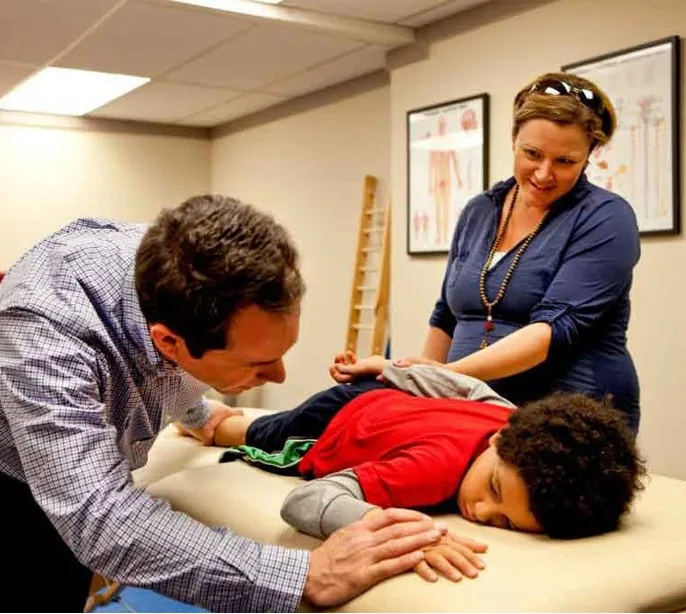
Sargent Goodchild guiding a child through a NeuroDevelopmental Movement session
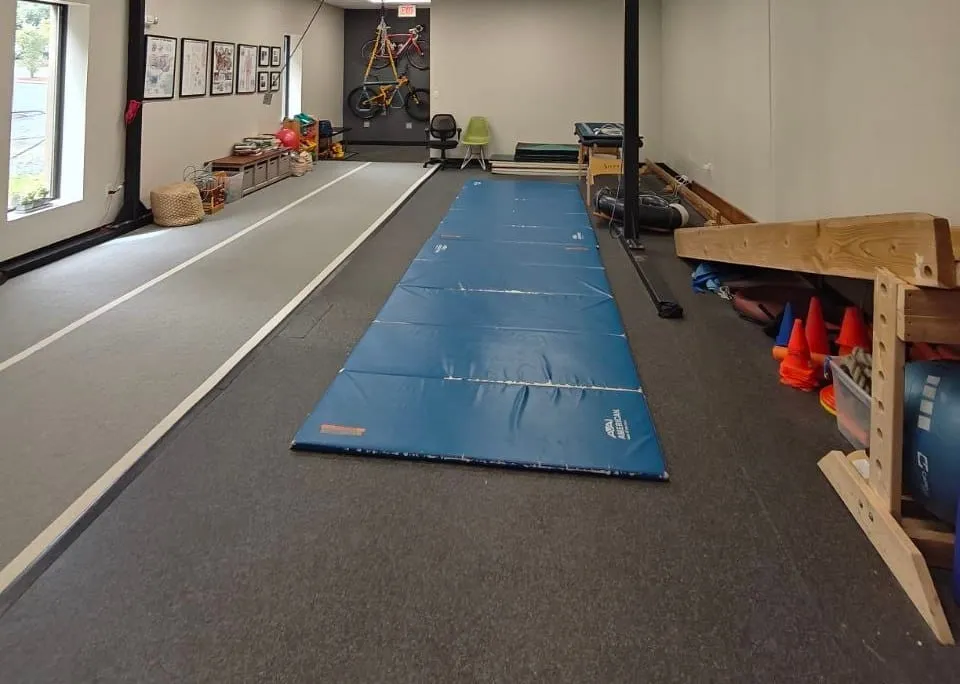
The NeuroDevelopmental Movement studio at Active Healing in Danvers, with floor mats, a movement runway and equipment

Where the work happens

A dedicated space to crawl, creep, balance and build

NeuroDevelopmental Movement is hands-on, floor-based work. Our Danvers studio is a real movement space, with room for the tummy-time, crawling, creeping and cross-pattern practice that replays your child's development in the order the brain expects.

Most of the work is done at home with you as the guide. The studio is where Sarge assesses, teaches you the patterns, and checks progress along the way.

How it works

The brain builds like a house, from the ground up

Six minutes of reading that will change how you see your child’s struggles.

01

The brain builds itself in order

In the first year of life, a baby’s brain wires itself together through a predictable sequence of movements: tummy push, belly crawl, hands-and-knees creep, then walking. Each stage builds the floor the next one stands on, from the brainstem up to the thinking brain.

02

Sometimes a floor gets skipped

Illness, prematurity, stress, injury, or simply too much time in baby gear can mean a stage gets skipped or rushed. The brain function tied to that floor can stay underdeveloped, and everything built on top of it has to work harder to stay steady.

words rules movement + touch
03

The lower brain only speaks one language

As Sarge puts it, the lower brain "does not have the ability to understand spoken or written language. The only language that the pons can understand is movement and touch." That is why talking, tutoring and willpower alone cannot reach it.

04

So we go back and finish the floor

NDM has your child repeat the missing early movements, giving that brain level another chance to organize. It rests on neuroplasticity, the brain’s real, well-established ability to build stronger connections through repetition. Quietly, the foundation fills in.

05

You become your child’s everyday therapist

After an assessment maps where the gaps are, Sarge teaches you the exact practices to do at home five days a week, about an hour a day. It is parent and child work, done together. He is honest that it is not an easy journey, and he supports you the whole way.

06

Change unfolds slowly, and it is different for every child

Families report gains in calm, focus, coordination, reading and connection. These are real personal stories, not guarantees. In the words of one practitioner, "some recover one hundred percent, some only a little." Honest hope, never hype.

The developmental sequence

Four floors, built in order

NDM works bottom-up, starting at the earliest level that shows immaturity and maturing each one in turn.

  1. 1

    Spinal cord & medulla

    Tummy time & pushing

    The newborn floor. Lying on the tummy, lifting the head and pushing with arms and legs. It builds the base that crawling is later built on.

  2. 2

    Pons

    Belly crawling

    Belly on the floor, pushing and dragging forward. Practitioners tie this stage to a healthy sense of belonging, touch awareness, reading-related eye tracking, and a more consistent state of calm and ease.

  3. 3

    Midbrain

    Creeping on hands & knees

    Up off the belly, working toward a cross-pattern creep. The first real work with gravity and balance, linked to the two eyes teaming up and filtering out noise.

  4. 4

    Cortex

    Walking, running, skipping

    Upright cross-pattern movement that emerges once the lower floors are complete. Linked to balance, motor planning, language and reasoning.

From struggle toward strength

What change can look like

4.8 · 22 Google reviews

Everything here is reported by families and by Sarge himself. They are real, consistently told personal experiences, not clinical proof, and outcomes vary widely. We share them as honest stories of hope, never as a promise of what will happen for your child.

Sarge's own story
Before

Diagnosed with severe epilepsy around age 5, on medications that did not control his seizures, and told by doctors he was "uneducable."

After

By his own account, seizure-free within about ten months of starting the movement work, with his last seizure at age 10. It then took a few more years to rebuild his academics. He went on to university and competitive athletics.

A parent, on Google
Before

A family looking for another path for their son after the usual options fell short.

After

"Active Healing is life changing. We are beyond grateful to have found Sarge for our son."

A parent, on Google
Before

An adopted child who came to the family with RAD, PTS, ADD and OCD.

After

"Sargent Goodchild has made an incredible difference in the life of our adopted child. He is a four-season athlete, and in show choir and robotics, at age 14."

Who it’s for

Children Sarge is asked about most

If your child is here, it is worth a conversation. If NDM is not the right fit, he will tell you.

  • Autism spectrum
  • ADD / ADHD
  • Seizure disorders & epilepsy history
  • Dyslexia & learning differences
  • Sensory processing
  • Cerebral palsy
  • Brain injury & stroke history
  • Coordination & handwriting
  • Attachment (RAD) & adoption trauma
  • FASD
  • Tourette’s, OCD, ODD
  • PANS / PANDAS

Why Sarge

Thirty years, and the patient who became the practitioner

Sargent Goodchild is the brain-injured, severely epileptic child who recovered through this work. It is why he has devoted his life to it.

  • 30+ years, full time. One of a small handful of practitioners doing this work. By his own estimate, only 18 to 24 people in the country do what he does.
  • A 60-year lineage. The method traces from neurosurgeon Temple Fay, to Glenn Doman and Carl Delacato, to today’s practitioners.
  • Sought out to teach. He has spoken for the Bioregulatory Medicine Institute, the Klinghardt Academy and Documenting Hope, and serves on several of their boards.
  • Families travel to him, from across New England, the country, and abroad. Remote video screenings are available.
  • Honest by default. "I don’t use it as a feeder system for my office. I use it as an opportunity to educate parents." If someone else can serve your child better, he says so.

Straight answers

The questions every honest parent asks

Is this a cure for autism, ADHD or seizures?

No, and anyone who promises that is not being honest with you. NeuroDevelopmental Movement is an educational, movement-based approach, not a medical treatment. We share real family stories as hope, never as a promise, because outcomes vary widely from one child to the next.

What does the science actually say?

We want to be straight with you. The principle underneath it, neuroplasticity (the brain’s real ability to rewire through repetition), is well-established. The specific method comes from a decades-old developmental-movement tradition that has not been proven in large controlled trials. What exists is 30+ years of hands-on practice and many family testimonials. We tell you this so you can decide with open eyes.

Should we stop our child’s medication or therapy?

No. NDM is meant to complement your medical care and existing therapies, not replace them. Keep your doctors and your therapy team fully involved, and never change medication without your physician. Many families do this work alongside therapies like ABA, OT and speech.

How much time does it take?

It is a real commitment. The work is parent-led and done at home, roughly an hour a day, five days a week, typically for 12 to 18 months. Trauma and attachment cases can take longer. The fastest Sarge has ever graduated a child from the program was 8 months, with profound, life-changing results. It is steady, patient work, and results are not instant.

Who does the movements with my child?

You do. Parents are taught to be the everyday therapists. Early on you gently guide your child through the patterns, and over time many children begin producing the movements on their own. Sarge teaches and supports you the whole way.

What is the difference between the screening and the assessment?

The $175 screening is a short first step where Sarge sees whether NDM may be able to help and whether you are a good fit. It is not the full evaluation. The Functional NeuroDevelopmental Assessment is the deeper, paid evaluation that maps your child’s nervous system and builds the actual plan. The screening is optional: some families skip it and go straight into the full assessment and program. If you are unsure, it is the low-pressure place to start.

The first step

Start with a $175 screening

You do not have to commit to a full program to find out if this path is right for your family. The screening is a short first conversation where Sarge looks at your child and your situation and tells you honestly whether NeuroDevelopmental Movement may be able to help.

It is not the full Functional NeuroDevelopmental Assessment, and it is not a sales pitch. It is not even required: some families skip it and go straight into the full assessment and program. If you are unsure, it is simply the lowest-pressure way to get a knowledgeable, honest read on whether there is hope here, and what a next step might look like.